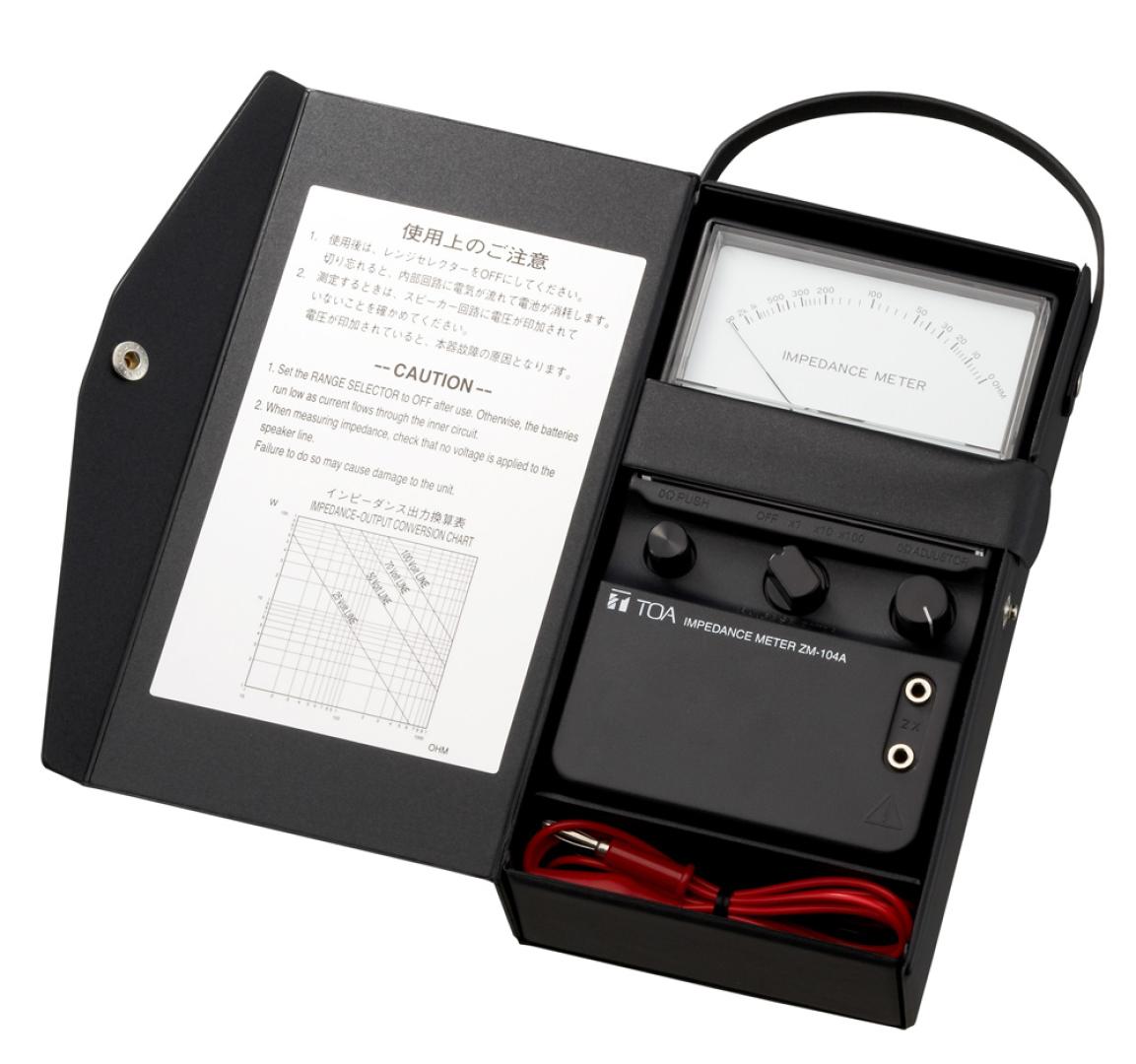
TOA ZM-104A

The TOA ZM-104A impedance meter is an essential item for any public address system installer, enabling the impedance of speaker lines to be tested quickly and easily.

Please note that a standard multi-meter cannot be used to measure loudspeaker line impedances - please read the attached flyer or contact us for further information.

  • For easy and exact measurement of speaker impedances including long cable runs
  • Battery operated for easy mobility up to 60 hours usage
  • Oscillator generated 1kHz frequency
  • 5 to 100kOhm range
  • Complete with protective case and test leads
  • Warranty: 1 Year

Click here to read our Blog post about Impedance Meters and why they are an essential tool for a commercial audio installer.

List Ex VAT: £325.00
Log in for Trade Prices

Please contact us for availability

CONTACT US

SPECIFICATIONS

Power Source R6 × 4 (1.5 V DC × 4)
Current Consumption 39 mA
Reading Direct reading meter, unit: Ω
Measurement Range × 1 range: 5 Ω - 1 kΩ
× 10 range: 50 Ω - 10 kΩ
× 100 range: 500 Ω - 100 kΩ
Accuracy ±10 %
Oscillation Frequency 1 kHz, ±10 %
Battery Life When Continuously Used × 1 range: 30 h
× 10 range and × 100 range: 60 h
Operating Temperature -5 ℃ to +40 ℃ (23 ゜F to 104 ゜F)
Dimensions 120 (W) × 220 (H) × 63 (D) mm (carrying case)
110 (W) × 180 (H) × 58 (D) mm (unit only)
Finish ABS resin, black
Weight 700 g (including carring case, without batteries)
Accessory Test leads …1 set

FAQs

1. What is the TOA ZM-104A?

It is a portable impedance meter for public-address and commercial speaker circuits. You use it like a continuity tester, but it reads speaker-line impedance in ohms instead of DC resistance, including long cable runs. Use it to check a new or existing speaker circuit before powering the amplifier: confirm there is no short, that the total load is within the amp’s rating, and that long cable runs have not pulled the impedance too low. It is aimed at 100V-line and low-Z commercial installs, not domestic hi-fi setup.

2. Why can’t I just use a standard multimeter?

A typical multimeter measures DC resistance. A speaker (and a 100V-line transformer) is an AC load, so the figure that matters for amplifier loading is impedance at audio frequency. The ZM-104A drives the line at 1 kHz and reads ohms on that basis. Commercial Audio Solutions notes that a standard multi-meter is not suitable for loudspeaker line impedances and points installers to their impedance-meter flyer. You can find a link in the Downloads section.

3. What measurement ranges does it cover?

Three switched ranges: ×1 (5 Ω–1 kΩ), ×10 (50 Ω–10 kΩ) and ×100 (500 Ω–100 kΩ). That covers low-impedance cabinets through to long 100V-line circuits with many tapped speakers. Accuracy is ±10%. The analogue meter reads ohms directly; multiply the scale by the range you selected.

4. How do I take a reading?

Plug in the supplied test leads, pick the range, zero the meter with the 0 Ω button and adjuster, then connect across the speaker line with the amplifier disconnected. Start on a higher range if the load is unknown. Measure speaker lines only, with the amplifier off and isolated. Do not use it as a mains tester or on live high-voltage circuits. 

5. How do I convert the impedance reading into amplifier load?

The meter includes a graphic impedance-to-power conversion table. On a 100V-line system, total load power relates to line impedance (approximately P=V²/Z). Add the speaker taps you intend to use, allow headroom, and confirm the measured line impedance matches that design load before you connect the amplifier.

6. How long do the batteries last and is it site-friendly?

It runs on four 1.5 V AA cells. Continuous use is about 30 hours on the ×1 range and about 60 hours on ×10 and ×100. The black ABS body is battery-powered for mobility on site and is supplied with a protective carrying case and one set of test leads. Weight is about 700 g with the case (batteries extra). Operating temperature is −5 °C to +40 °C.